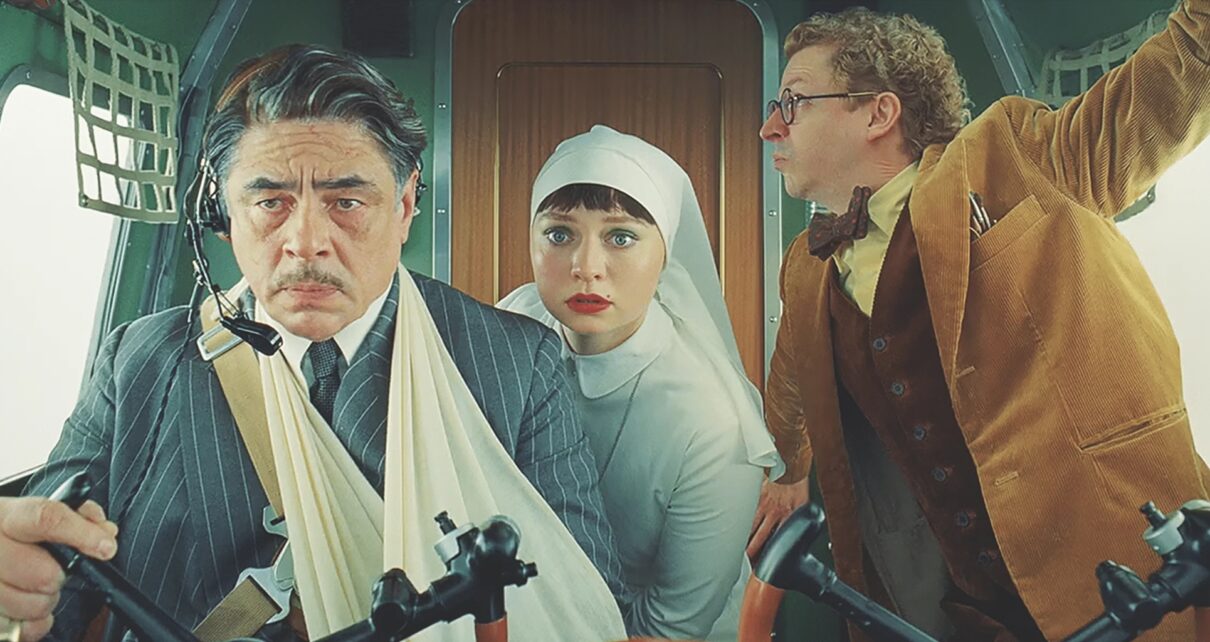
Those not already privy to the Wes Anderson secret handshake must find this stuff confusing. rest assured: This is a typical Wes Anderson setup and presentation; it just looks like a private joke where everybody knows the punchline but you. Trust me: Nobody knows the real punchline but Wes Anderson … and sometimes you get the joke. Sometimes … less. The Phoenician Scheme is a “less.”
A billionaire’s private jet practically rips in half while in the air and the billionaire’s reaction is completely subdued, if not out-and-out surreally calm. Oh, this is just par-for-the-course, as Anderson Acolytes will tell you. All of Wes Anderson’s films combine other-worldly experience with the reactions of a straight man in a comedy duo. All framed in a storyboard come to life. In the Wes Anderson oeuvre, I’ve usually found the experience amusing, delightful, insightful, entertaining.
Today? Less.
Zsa-Zsa Korda (Benicio del Toro) reacts to the attempt on his life and sixth (?) brush with aviation death in the way only a tycoon (when is the last time that word was used?) in a Wes Anderson film would – he wills everything to his estranged daughter, Liesl (Mia Threapleton), a nun – an independent nun, apparently- and then makes a point of figuring out why he just did this. Korda has Mia and Bjørn (Michael Cera – in quite likely the best role/performance of his career), a rando entomologist follow him around for the rest of the film so that he can get to know his daughter better.
Meanwhile, he has a money-making idea, The Phoenician Scheme, to enhance his investments by taking advantage of all his business partners, which he attempts one at a time. IMHO, it is perfectly reasonable to be scornful of these attempts at plot as the whole darn rodeo is a ruse to let adventure and imagination soar in lieu of a genuine plot one might find in a film that makes sense.
[And when I say “soar,” I mean not soar too far, of course. This is a Wes Anderson film, after all. Imagination must be confined to the pastel-themed box in which the eccentric characters are placed in order to do minimally eccentric things.]
In turn, the film offers Tom Hanks, Bryan Cranston, and Riz Ahmed playing horse (?), revolutionaries, more private plane hijinks, assassination attempts, Scarlett Johansson, and a meet-and-greet where the guest is always offered a hand grenade. Honestly, when I lay it all out like that, it sounds pretty good, right? And if I’m being honest, parts of The Phoenician Scheme are “I’m smiling” enjoyable. But then you ask your self, “Why?” And the answer, invariably, is something to the effect of: “Because it’s fun to see Tom Hanks, Bryan Cranston, and Riz Ahmed dressed retro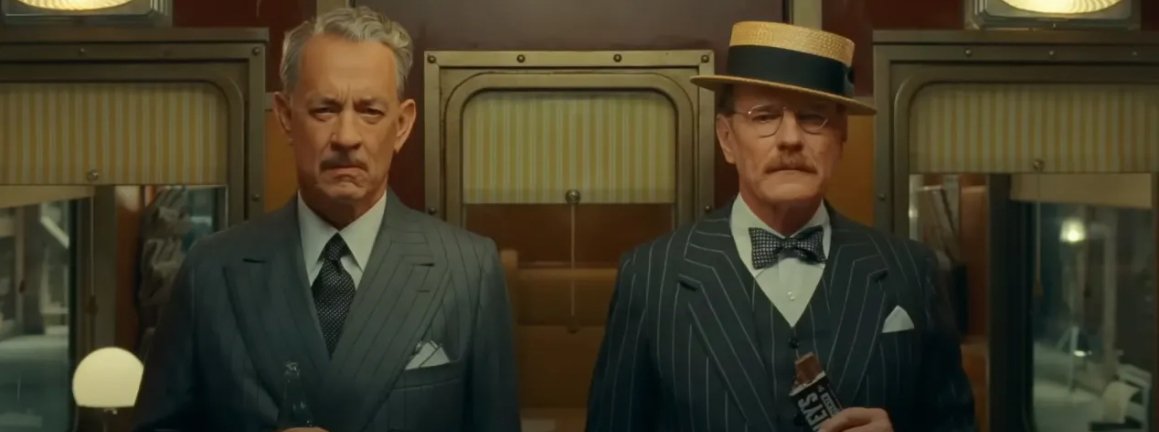 for ‘calisthenics,’ that’s why.” But not a lick of it meant anything, plot-wise or otherwise. As a result, no visual or attempt at humor seemed to get above the owner’s own self-conscious amusement. At no time, did I ever get lost in either entertainment or enjoyment. The film was a constant self-conscious search for the idea of entertainment as if entertainment itself were being explained to alien beings.
In retrospect, this is the kind of film that makes me embarrassed for having praised Wes Anderson so often in the past. And it’s not because The Phoenician Scheme is a bad film. It isn’t. It is entirely because The Phoenician Scheme highlights the inadequacies of the controlled chaos that is Wes Anderson storytelling. He wants credit for the “errant” crossbow shot that barely misses the protagonist; he wants credit for the protagonist’s minimal reaction to the errant shot; he wants credit for having Scarlett Johansson both play down and play up her sexy reputation simultaneously; he wants credit for making Tom Hanks and Bryan Cranston look like they belong in a 1950s locker room … but we get no real sense of why any of these things are the way they are. Yeah, that’s classic Wes Anderson, but when plot and motivation are both such elusive animals, it feels like indulgence for the sake of indulgence. Yes, that probably could be said if every Wes Anderson film, but it comes off as a “nice touch” when the story works. This one doesn’t and it all looks like somebody came up with the storyboards long before they came up with the plot.
There once was a tycoon named Korda
Of whom nobody could comment, “I’m bored-a”
He had a mighty plan
To exploit every man
Profits? No, but scheming is its own reward-a
Rated PG-13, 101 Minutes
Director: Wes Anderson
Writer: Roman Coppola, Wes Anderson
Genre: Wes Anderson
Type of being most likely to enjoy this film: Wes Anderson die-hards
Type of being least likely to enjoy this film: “What s going on here?”