Stolen Valor: it’s not just for fake soldiers, amIright? This week’s addition to the: “Why was this made?” club is all about Stolen Valor, but of a much different variety than we are used to. And speaking of things we aren’t used to, this is also the feature-length directorial debut of Scarlett Johansson, who, if nothing else, has figured out how to get me to cry.
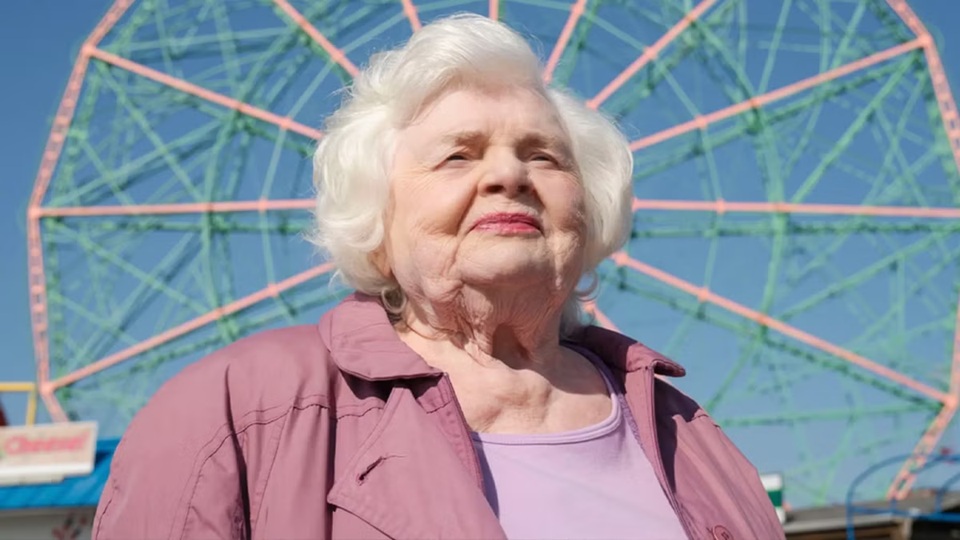
Eleanor Morgenstein (June Squibb) and Bessie Stern (Rita Zohar) are ancient best friends. They live together. Hold up. Don’t get too attached. Oh, too late. Bessie died and you’re in tears. Yup, I was too. They were a gay couple, right? No?! But they lived together for a decade. Oh, both widowers of fifty-year marriages. OK, but they’re gay, now, right? I mean, before Bessie died. And this whole film is about how these two repressed their lesbianism for the sake of society and family, right?
What?! That’s not this film at all?
Ok, well, it’s not the film that’s on screen, but you’re not gonna convince me these two were never hot for one another. Jus’ sayin’.
No, this film is about something else entirely. Eleanor and Bessie lived in Florida. After Bessie’s death, Eleanor went to live with her daughter’s family in New York. Lacking for other friends … [Oh, COME ON; you’re really telling me Eleanor and Bessie were “just friends?” Sorry, ok, letting it go.] … Eleanor is encouraged to join a group at the local JCC. I dunno if either the idea and the execution was bad or the idea was good, but something got lost in translation. Either way, Eleanor wanders into a support group for Holocaust survivors.
Eleanor is NOT a Holocaust survivor.
Bessie, however, was. And Eleanor knows Bessie’s story cold.
So while the proper thing to do is say, “I’m so sorry. I did not survive the Holocaust and you people are all amazing tributes to longevity and endurance in the face of pure evil.”
But, if course, this is a movie (albeit based on real life). Eleanor does no such thing. Instead, she tells Bessie’s story as her own and attracts some attention when an NYU student likes the tale of evil better than those of her peers who aren’t lying. I’ll leave it there.
Am I going to ride a 94-year-old for garnering a little unearned attention? No. But I’m also not going to laud her for it. We are in a post-truth world. We are in a world in which the President lies to us every single day in matters big and small …and he is blanketed from even the smallest of fact checks by layers and layers of insulation in the form of sycophancy and an entire media ecosystem of evil. This has filtered down to the populace in myriad ways from localized narcissism to catfishing. ScarJo – did you really want to make your heroine a liar?
The next question is: Who is Eleanor the Great for? Why was it made? I could see “Holocaust awareness” as a general theme, but I keep running into the part where the focal point of our attention did not survive the Holocaust and it is huge distraction. The film did make me weep on three or four separate occasions. So, hey, good for you, film. But if your film has little to say because it has championed a liar, well, this feels like pity-porn. Do better next time, everyone who made this.
There once was a woman, Eleanor
Left alone, she decided for more
But her lies crossed a line
Claiming hardship as “mine”
Putting off well-wishers by the score
Rated PG-13, 88 Minutes
Director: Scarlett Johansson
Writer: Tony Kamen
Genre: Why was this made?
Type of being most likely to enjoy this film: People who like to cry
Type of being least likely to enjoy this film: People resentful of unearned status