When it comes to WWII atrocities, it is important to remember the timeline. Nazi Germany openly advertised merely selected excerpts of its evil; we didn’t get the full book until the war ended. Hitler made no bones about hating Jews in real time, but the death camps were a mystery to the vast majority of the people outside Nazi Germany. Hence, the true evil of genocide was like a gender reveal party for the invading allies. SURPRISE! Did you guess “black hearts?” We suck even more than you had ever imagined.
The question this film bookends with is: “Could it happen here?” And of course it can. It is happening here. This what happens when you put a racist, angry, cruel, fact-free, and feeble-minded demagogue in charge and take away the guardrails. We should all be thankful Trump is as stupid as he is; we’d be much closer to Nazi Germany than we already are.
But I digress. This film is about the man who trod this evil path decades before Trump figured out it could put him in the White House.
Hermann Göring (Russell Crowe) was Hitler’s #2. He was narcissistic, evil, and racist (like Trump), but -unlike Trump- he was also calculating, family-conscious, and very intelligent. Seeing his empire fall, he made a conscious decision to take on the allies through the justice system rather than with weaponry. He believed he could and would win the legal battle. For one thing, International Law was not a thing in 1945. How is one country to say how another country should act, huh?
Upon the arrest of Göring, US Supreme Court Justice Robert Jackson (Michael Shannon) pushes for an International Tribunal. It is hard to say exactly how important this moment is – from the perspective of a Supreme Court Justice one can see this as the utmost importance – to hold Germany accountable for its evil while the world is watching. Of course, the allies did that in WWI only to find Germany more formidable than ever twenty years later. Would legal accountability really mean that much? Of course, we are living now with the consequences of recent SCOTUS disaster rulings. We could have held Trump accountable for January 6, for fake elector schemes, for mishandling and theft of top-secret documents. SCOTUS not only let him off the hook, it paved the way for the fascism we see in America today. So, I’m of two minds here. I’m inclined to believe whatever the court found of Hermann Göring’s guilt or innocence, history probably doesn’t change, BUT it sure is nice to know that at least post-WWII, we had a plan for dealing with fascism in the moment.
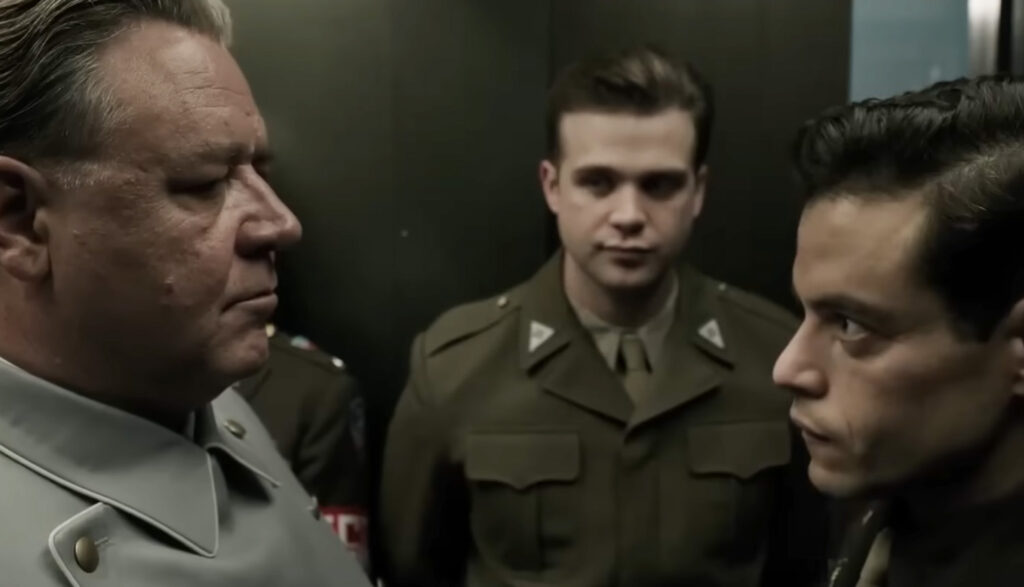
Film-wise, Jackson is an afterthought. The trial is an afterthought. Nuremberg is about the relationship between Hermann Göring and army psychologist Douglas Kelley (Rami Malek). Kelley is ordered to get a psychological impression of Göring and all the other high-ranking Nazis to be put on trial. Secretly, however, Kelley wants to figure out Göring; Kelley wants to know if there is a tell that sets off the Nazi evil. Is it something German? Is it something inhuman? He is determined to analyze Göring as much as he can. Meanwhile, Hermann Göring is receptive because 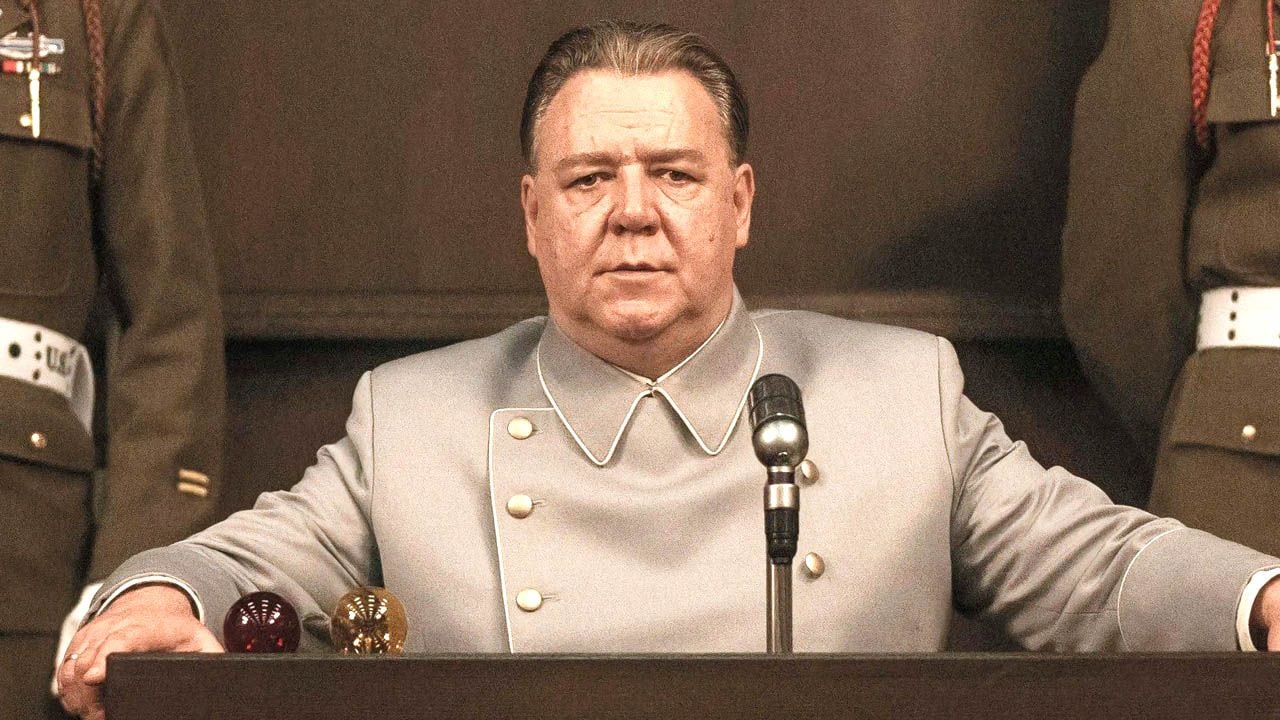 developing a friendship [yes, a friendship] with Kelley gets him access to his family. In addition, Kelley is the only person with access to Göring that doesn’t treat him like a war criminal.
The film is made by the interplay between these two academy award winners. And it isn’t hostile or upstaging acting. This is simply two wonderful actors so deeply embedded in their roles that we are riveted by any piece of dialogue between them. We know exactly what each one wants, and the two characters have a mental chess match while the two actors also have their own chess match of sorts. While the former is competitive, the latter is more cooperative, as if they’re playing a game to see how long it can go until checkmate. This part of the film works quite well.
In the wake of WWII reexaminations, Nuremberg wanted to be another Oppenheimer. It’s shy on several counts, but one of them is not quality of performance. Russell Crowe and Rami Malek are at their best here. Where it falls significantly shy of Oppenheimer, however, is impact. We get so involved in the relationship between Göring and Kelley, we forget Göring is a monster, among the most evil, soulless demons ever to walk the Earth. Hence, not only does humanizing him take away from this feeling, it means that no ending to this film could be proper. The Nazis murdered 6 MILLION JEWS. [Yes, that isn’t all they did, but this is the headline offense.] Göring was part of everything … every decision and, at least indirectly, every execution. At some point, finding him -like Trump- guilty or innocent doesn’t matter because we can only derive satisfaction once. But if I’m being honest? The courtroom battle was much more anti-climactic than I had anticipated, especially for a 140-minute build-up.
There was once a Nazi named Göring
Whose arrogance was outwardly glaring
They put him on trial
Are true to his style
His countenance left all onlookers swearing
Rated PG-13, 148 Minutes
Director: James Vanderbilt
Writer: James Vanderbilt, Jack El-Hai
Genre: Damn right, it’s relevant
Type of being most likely to enjoy this film: Historians
Type of being least likely to enjoy this film: Nazis