Could it happen here? Of course it could happen here. What is “it,” exactly? Jailing and/or murdering perceived enemies of the state, no matter how innocuous, and regardless of any proof of crime committed. Will it happen here? Well, shit, this is exactly where Trump II is going, isn’t it? Trump ran and won on lowering egg prices. Egg prices are at this time much higher than they ever were under Biden. Is there a plan in place to lower them? No. Is there even an idea of how to lower them? Also, no. But this administration sure acted with alacrity to prime potential concentration camps (Guantanamo, El Salvador), didn’t it?
This is what you assholes voted for. I don’t know exactly what you think you voted for, but this is what you actually voted for. Under Trump, prices will go up, human rights will go down. Count on it.
Reflecting the trauma of the exact time we live in is an eerily prognosticating look at history called I’m Still Here. Rio de Janeiro of 1970 was not a friendly place. There is a police presence everywhere. There are roadblocks and random searches and playing the match game with wanted posters going on. The Swiss ambassador was kidnapped … “WHY?! This really happened?! What did Switzerland do?” Never mind the politics that went into that; the important part is this Brazilian government is using such as an excuse to crack down on perceived dissidence. And they aren’t being subtle about it.
Meanwhile, there’s a well-to-do family with too many children. They live near the beach and go there all the time. Rubens Paiva (Selton Mello) is a former congressman. He spends his days supporting ex-pats with his extensive penpal skills. Eunice Paiva (Fernanda Torres for most of the film; Fernanda Montenegro as old Eunice) holds the family together. For most of Act I, they don’t need much holding together. There aren’t any crises, and the children go about their usual whatever that usual is. Their multi-layer flat is just a way-station for constant foot traffic.
And then the police get involved. Secretive men take dad for a “deposition.” We know he’s not returning. The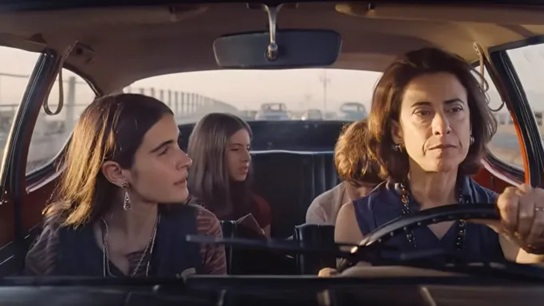 film knows he’s not returning. Eunice and the kids, however, did not get the memo. This is the way of fascist regimes, and it’s quite clear that 1971 wasn’t a good year to live in Brazil. The rest of the film is the fallout; oh, and there’s one more BIG plot point I won’t tell you here.
I’m Still Here is one of those films that remains more important than it is good. It’s important in a few ways: one in that this is a playbook of what to expect from the fascist regimes that have emerged in our time – and Americans, you are not exempt here. The second is that Fernando Torres gives a moving performance as a wife/mother caught in the cross stream. Want to know what your life might be like in two years? Check out this performance. OTOH, I’m Still Here is slow-moving and not terribly intuitive. Yes, the monsters are here. Got anything to say about them other than they are monsters? No. Ummm, ok. This picture reminds me of one from my youth, Missing, which was better. We should applaud I’m Still Here for pointing out the flaws of the age we live in, but we should also try to hold it to the Missing standard.
There was once a Rio housewife called Eunice
Whose world collapsed into a great void of blueness
For the police came one day
And stole her husband away
Now pain and false hope are her trueness
Rated PG-13, 137 Minutes
Director: Walter Salles
Writer: Murilo Hauser, Heitor Lorega, Marcelo Rubens Paiva
Genre: Trump administration playbook diagrams
Type of being most likely to enjoy this film: People who believe in democracy
Type of being least likely to enjoy this film: Fascists