“Does Riz Ahmed have hearing issues?” That’s what I googled immediately following Relay. I ask this because we all saw him play a deaf character in Sound of Metal and damned if he didn’t suggest that dynamic again in Relay. He spends over half the film playing a solitary man conversing through Relay, a hub setup for deaf people who wish to communicate by phone.
Of course, Relay isn’t for the deaf so much as people with clandestine issues who do not want their voices recognized. And this is where we begin.
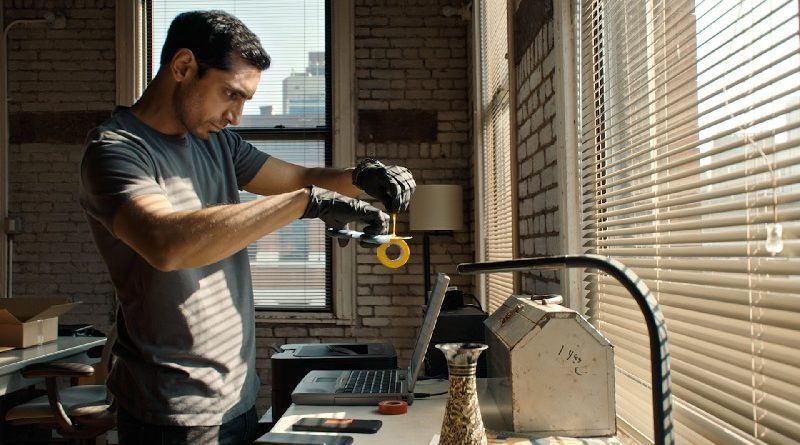
Ash (Ahmed) is -how shall I put this- a whistleblower’s pal (for a small fee). It works like this: say you have some whistleblowin’ to do, but fear retaliation from your employer. In the Trump era, this is a HUGE concern. Oh yeah, many employers will tell you they want you to speak out and HR will let you know your rights, but … this is not reality. And if your company is up to some unlawful shit, and it’s more cost effective to eliminate you than face the music, guess what they’re gonna do? And Trump has signaled far and wide that his DOJ isn’t interested in taking down corporate magnates. It is interested in eliminating regulations that might hinder a lawless corporation. Ash is the guy you contact when you need protection from corporate.
The opening scene lays it all out for us: A CEO meets a nothing at a coffee shop. The nothing hands over the dirt to get his life back and is protected because a third party (Ash) holds a copy of the mischief should anything happen to the nobody. The nobody has never met Ash. Neither has the CEO. That is by design. There is elaborate anonymity going on. It’s all part of the game. For several minutes, it is difficult to tell who is a good guy and who isn’t. The man that follows the nobody the Grand Central Station and watches him get on a train really just wants to protect the nobody; he’s following and watching not out of some diabolical chess match tactics, but because he cares; that’s it.
The plot begins when Sarah (Lily James) decides to go down this road. She has some choice information about an evil employer and the law firm she has 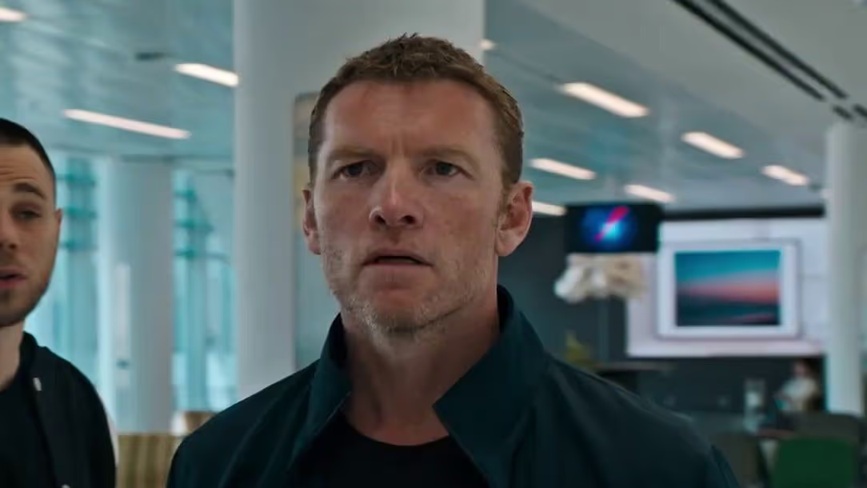 entrusted won’t touch it. But they refer her to the service Ash provides: Anonymous help at a reasonable price. Meanwhile, corporate has sent a team of goons, led by Sam Worthington (!) to harass Sarah. That’s their job.
It is worth note here that Sarah has the ability to blow the whistle on her former unlawful employer, but has since decided not to. She just wants her life back. That probably can’t happen once the corporation has started sending goon squads. This is quite the cat-and-mouse film: communication among the factions is almost entirely by Relay, where pleasantries are non-existent, thoughts can get cut off, and real voices go unheard. More than once we worry that Sarah has not understood Ash’s instructions completely. On the one hand is a single anonymous man in New York trying to protect his client and himself. On the other are four people stakes out in a van willing to go to almost any length to control the situation.
We all know darn well that if anonymity is breached, it’s game over, corporate wins … and likely a few deaths will follow.
I’m sure many will see Relay as a run-of-the-mill thriller; a little far-fetched, perhaps, and a little Robin Hood-ish. I see it as a little more. There are lone crusaders; there are corporate bullies; there are nobodies who sacrifice everything on the mere hope that the truth will make the world a better place. The name Christine Blasey Ford immediately comes to mind. She lost. She lost in just about every way a person can lose. And she knew she would lose. But she spoke out anyway. Relay is no To Kill a Mockingbird. This is an action/thriller, not a commentary on society, justice, and politics … but both tales are born from the same place. It’s a noble place, and this is a good thriller.
There was once a facilitator named Ash
Who knew what inner-workings to crash
But this Hood, he was nice
So set out to help mice
But you know they’ll all face some backlash
Rated R, 112 Minutes
Director: David Mackenzie
Writer: Justin Piasecki
Genre: Modern whistleblowing
Type of being most likely to enjoy this film: Whistleblowers
Type of being least likely to enjoy this film: Their employers