Are you sure this isn’t an Angel Studios film? It’s got all the earmarks: over-the-top emotion, skeletal plot, emotionally manipulative, subtle hints to White Supremacy, not-so-subtle invocations of Christ. And, oh yes, terrible acting. Miserable. Just miserable.
Let’s get this over with. Soul on Fire is the real-life story of John O’Leary (Joel Courtney as an adult, James McCracken as a pre-teen mummy), a St. Louis kid who set accidentally himself on fire in 1987. The film pays a lot of lip service as to how unlikely his survival was (“less than 1% chance”), but the film couldn’t seem to convey such in more than words. The key thing is that John became an inspiration to all when he learned to walk again and manipulate tools without the use of his fingers, lost to the fire.
Did he lose toes to the fire? How about *gulp* other appendages? The film doesn’t say (or not the part I saw, at least).
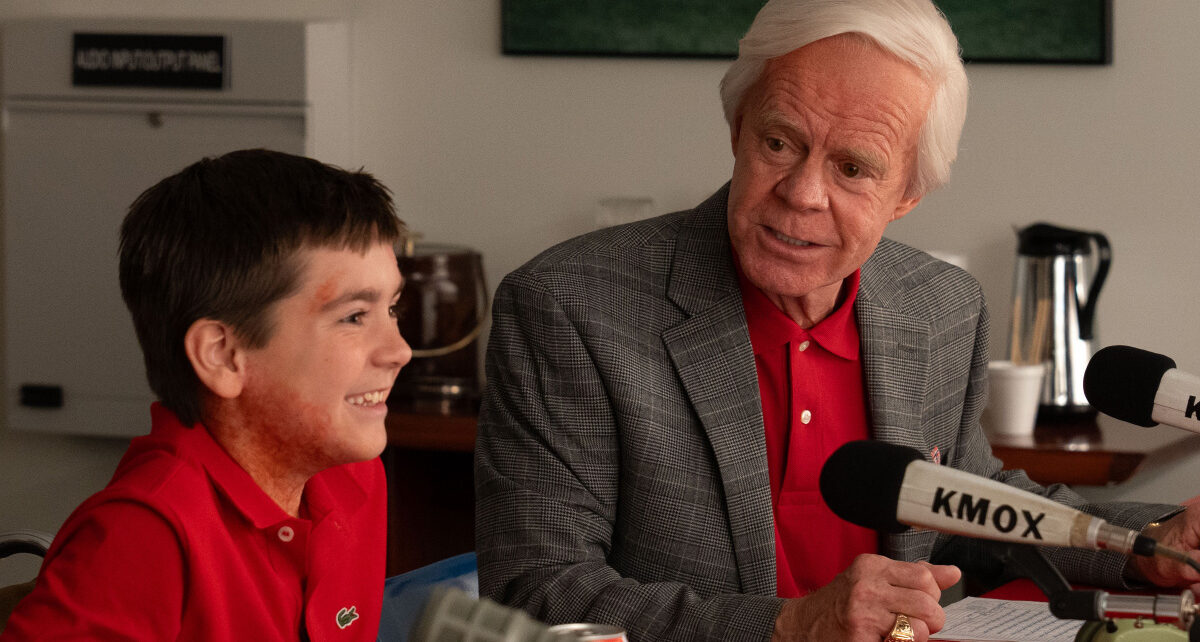
The key to this story is that the 9-year-old burn victim caught the attention of Hall of Fame baseball announcer Jack Buck (William H. Macy). Hence, the kid’s fate became part of St. Louis Cardinals lore, not unlike the Jimmy Fund in Boston, or whatever your local charity case that went viral.
I don’t have anything against John O’Leary. I’m glad he lived; I’m glad he recovered; I’m glad he’s an inspiration for all. That’s the way it should be. Soul on Fire, however, is a different story. The film sugar coats the pain, presents a ridiculously one-dimensional and positive look at its subject and the players surrounding him, and breezes neatly over the obvious – that if John O’Leary were black, his story would have been very different.
Much like Angel Studios, Sony chose to include color in this film solely for the purpose of not appearing racist. Hence, there are speaking roles for the piano teacher, the physical therapist, and the hospital janitor, all people of color. There is a fine line, however, between racial inclusion and pandering to the point of condescension. See if you can spot it in this scene: 9-year-old John O’Leary is finally ready to leave the hospital after five full months in traction. The head doctor leading a group of interns asks aloud who is the person “most responsible” for John’s recovery. The interns cite the doctor himself, then patient, then give up. The doctor, seeing no correct answers, summons the janitor, calls him by name, and states that burn victims a more susceptible to germs than other types of patients, hence keeping John’s environment clean was the key to his recovery. Yay, janitor guy!
This is pathetic movie making. You’d roll your eyes if you saw this on a PBS show aimed at your four-year-old. And do we see the janitor ever in the film again? Of course not. This is lip service. This is window dressing. This is condescension and insincerity at its finest. Oh, there might have  been a genuine feeling of inclusion from, perhaps, a source or two, but when you go out of your way to thank the janitor, who just happens to be the only black guy in the room? Puh-lease.
I was not unmoved by this picture. Sure, li’l Johnny being wheeled into surgery telling his mom, “I want to LIVE!” is going to get to you; how could it not? But even then, it is hard not to feel manipulated. You know this scene never happened. There’s no way the doctor delays life-dependent surgery for a Hallmark moment. None. And there’s no way mom has a “you need to want to live” conversation with her child in the moment. None. Parents, tell me, you’ve just discovered your child has gasoline burns over 100% of his body. You get ten seconds with him before surgery; how do you react?
Yeah, John O’Leary is an inspiration. I hope that if I ever blow myself up, I can one day become a motivational speaker as well. But I didn’t like this film, and I can’t help thinking that without being white, male, and born to wealth, his story would never have escaped his block.
There was once a burn victim called John
Whose future had to be completely re-drawn
Without fingers instead
He just plowed ahead
To become a handi-capable pawn
Rated PG, 112 Minutes
Director: Sean McNamara
Writer: Gregory Poirier
Genre: Films you’d swear were made by Angel Studios
Type of being most likely to enjoy this film: Those in need of white inspiration
Type of being least likely to enjoy this film: “Good Lord, is this manipulative”