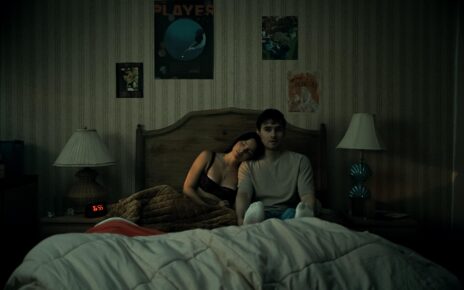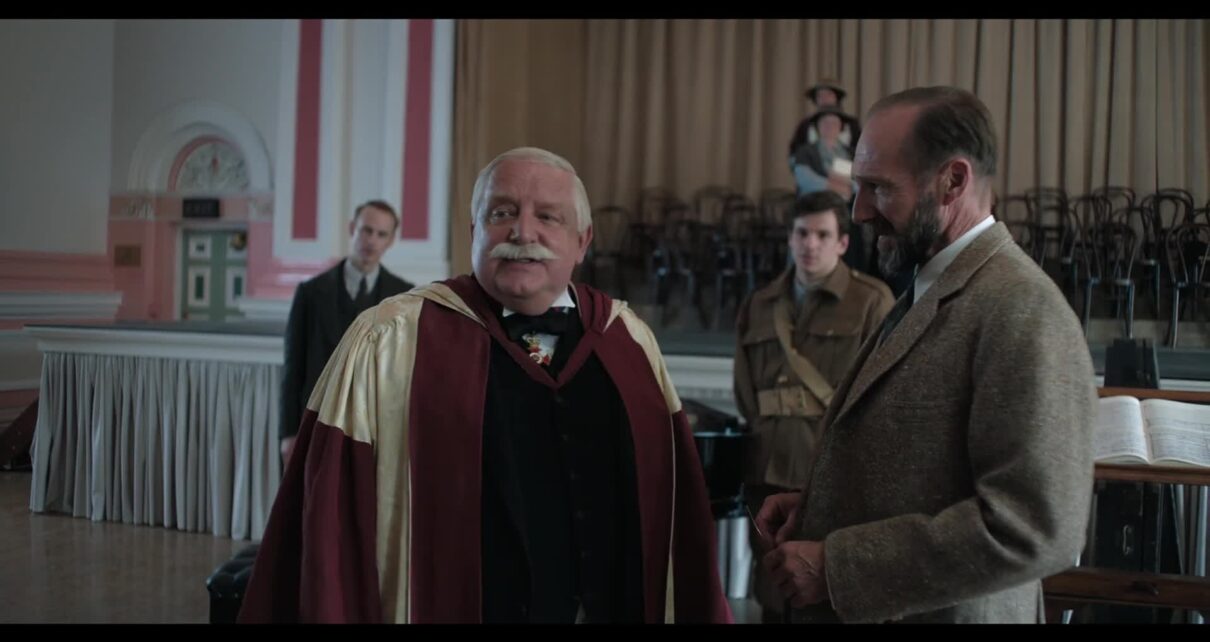
Ramsden, Yorkshire, 1916, a time and place where the thoughts on every young man’s mind are war or getting laid … but not necessarily in that order. For fear of making The Great Porky’s War, Nicholas Hytner focused on The Choral, an all-volunteer town chorus made up of people who actually like to sing, people who like to be in movies, and young men who think this improves their chances of getting laid.
As 1916 rolls on, The Choral has two big issues before it: the first is that the director has enlisted to go fight Germans, the second is that the scheduled performance, St Matthew Passion, was written by Bach, a German composer. Oh, it’s not going to get any better for the German-haters of Yorkshire: the proposed replacement director is Dr. Henry Guthrie (Ralph Fiennes), a man who has spent a large part of his life living and composing in Germany. Reluctantly, the powers that be settle on Guthrie for lack of anyone else. Strangely enough, they weren’t wild about his homosexuality or atheism, but the sticking point was the German thing. What sealed the deal was Guthrie’s proposed change in music: The Dream of Gerontius by Edward Elgar.
If you know what this piece of music is, congratulations. You are a better man than I.
And this is the film: getting a wartime small town of horny boys and the women they chase to create a performance that no one will see. The stakes are low; the drama is unremarkable; the overwhelming factor among all the subdued noise is The Great War, and, yet, its effects on Yorkshire are indirect – the kid who delivers the death notices, the widows, the stream of wounded at the local hospital, Guthrie’s pianist acting as “conscientious objector,” the boys not yet old enough to serve, the recruitment photographer, etc. Every little part of this town is marked by the war in one way or another, and yet the war hasn’t directly found Ramsden and never will.
I think this film wanted to introduce us to some bright new English talent, but, honestly, all them white Yorkshire kids look the same to me … and no matter how they tried to distinguish themselves, 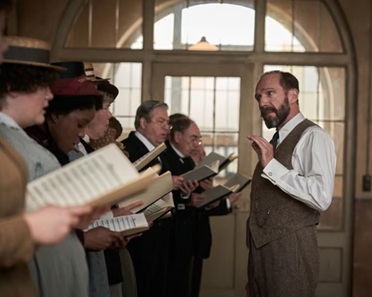 the three main boys all shared the same dream of getting laid and going to war. The young standout the film featured instead was Amara Okereke, who might have been the only young black woman in the town. As both the champion of looks, voice, and virtue in this town, The Choral went out of its way to introduce her stardom. The woman is certainly talented, for a small town, and I leave it at that.
The Choral comes off as a very slice-of-life film: this is what it was like to live in Yorkshire in 1916 – we hated the Germans, we mourned our dead, we made due, we felt the war even if it wasn’t at our doorstep. That’s terrific; I sure love knowing what it is to live in a different time and place. But there isn’t anything else to this film. It’s like taking a time machine, dropping you off for two hours, and calling you back. That might do it for some. That didn’t do it for me. OK, Elgar’s music is underrated and Lord Voldemort makes a decent chorus master; so tell me, do the boys get laid or not?! If that’s all you really want to know, have I got a picture for you.
There once was a maestro Guthrie
Lived for years in old Germany
That didn’t light a fire
In English Yorkshire
But judgment gave way to practicality
Rated R, 113 Minutes
Director: Nicholas Hytner
Writer: Alan Bennett, Stephen Beresford
Genre: Movies we pretend aren’t for old people … but are
Type of being most likely to enjoy this film: The descendants of Edward Elgar, I hope
Type of being least likely to enjoy this film: “I’d love it if this film had a point”