Totalitarianism has a happy ending, huh? Well, gosh, I don’t remember reading about that. I guess the USSR turned out fine after all, didn’t it? Among the greater disappointments of the past year in cinema is the Andy Sirkis adaptation of the classic novella Animal Farm, George Orwell‘s painful attempt to teach middle schoolers about Leon Trotsky. In the hands of Andy Sirkis, the book has been Gollumed away to the point of “Why did we do this again?”
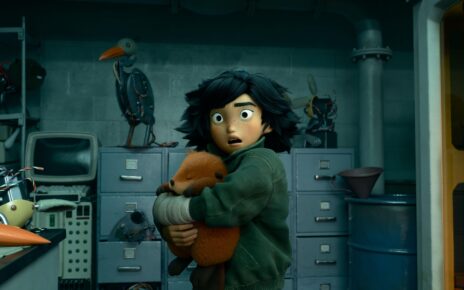
To be clear, I liked this film up to a point. Sure, it is a tale about a piglet named Lucky (voice of Gaten Matarazzo) who doesn’t appear anywhere in the book, but, hey, adapted means adapted, right? Lucky is our guide to this political commentary as the optimistic and highly intelligent piglet dreams of an ideal commune where all animals are equal. They were very close to “all animals are food” (where they all truly would have been equal) for the farm had been repossessed and all the critters sold to a slaughterhouse before they collectively realized their fate and rebelled.
Ok, we’re good so far. Sure, it wasn’t quite the Russian Revolution the book parallels, but it was a revolution and it established Animal Farm, an edenic, animal-run community where the anti-human laws are printed on the water tower for all to see:
NO CLOTHES
NO BEDS
NO ALCOHOL
NO KILLING
ALL ANIMALS ARE EQUAL
These ideals will be challenged, obviously. But they make a nice tale for the next five seconds.
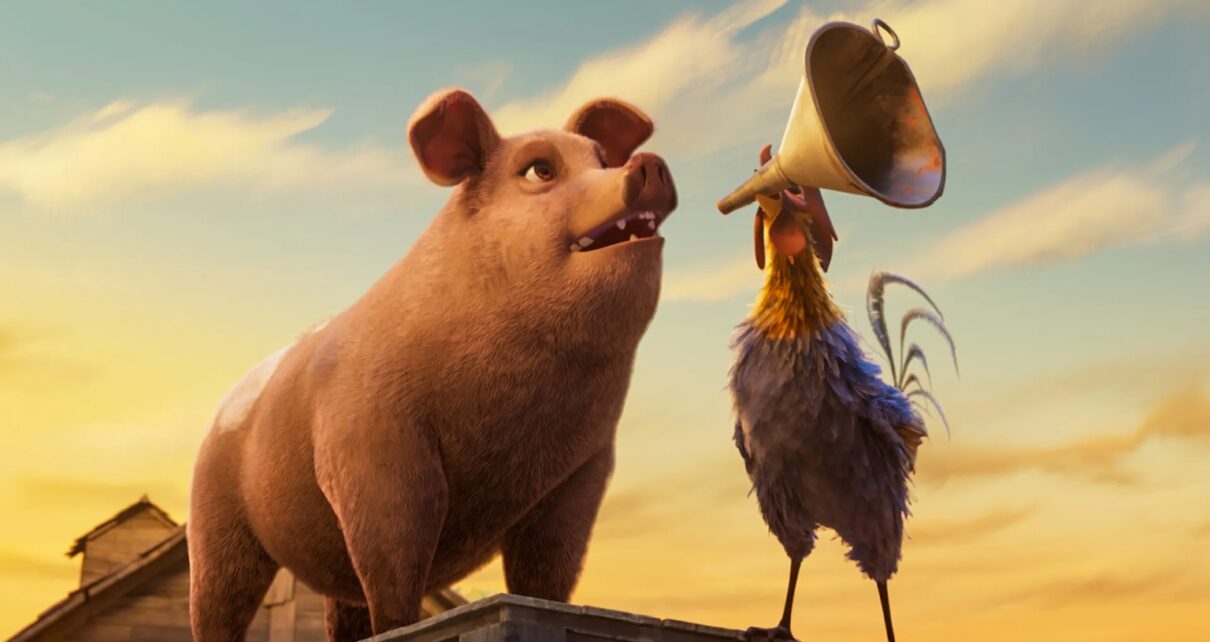
The unofficial leader, a pig named Snowball (Laverne Cox) has an idea to build a watermill to capture electricity in order to run the milking machines so the not-so-dexterous pigs don’t have to. When Snowball puts it to the farm, a bossy boar named Napoleon (Seth Rogan) seizes this opportunity to malign Snowball, scrap the project, and take power. Thirty seconds later, Snowball is run off the farm, never to be heard from again.
Ok, the pacing is wrong and this isn’t quite the Stalin-Trotsky conflict I remember BUT this scene parallels MAGA perfectly – a desire for power so strong that they’ll gladly hurt themselves in order to obtain it? That is MAGA/modern Republicanism to a “T.” From supply-side economics to DOGE, there are plenty of examples of MAGA cheering on societal regression in order to consolidate power. Heck, that may as well be the FOX motto: “Gladly sabotaging America to keep Republicans in power.” And Napolean? Well, he’s a selfish classless megalomaniacal fat pig with tacky tastes, a huge ego, and no tolerance for dissent. If he were a little stupider and a lot more corrupt, this would be Trump in animated form.
And thus ends the part where I enjoyed the film, sadly. The desire to add new elements to the Orwell story: the conscience-challenged Lucky, a billionaire, and a bank rep take a fantastic cautionary tale about how Russia FAFO’d and 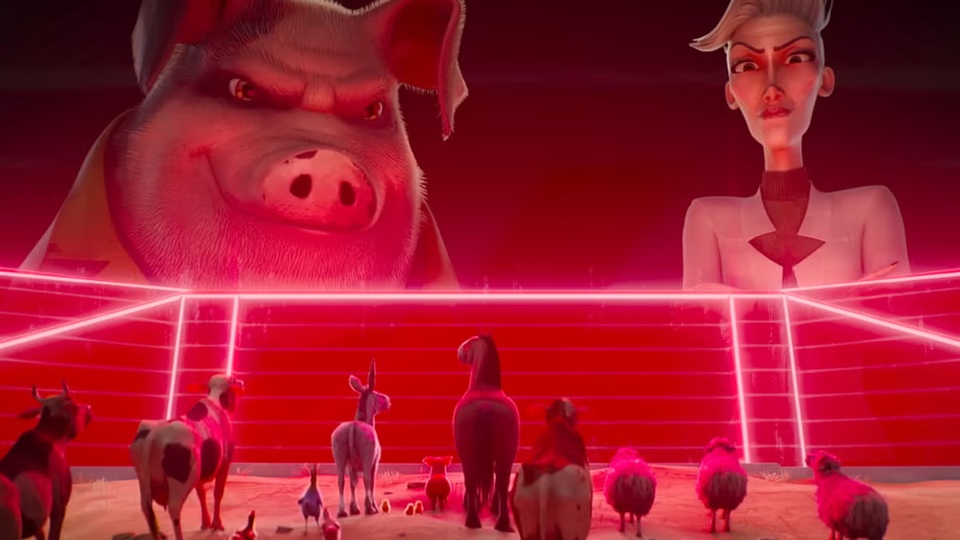 turned this would-be political commentary into a circus of mismatched metaphors. And don’t get me started on the happy ending.
Animal Farm should not have a happy ending. Let’s be quite clear about that. “Oh, so everything turned out all right for the Russians in the end?” Does it look like everything is going swimmingly for Mother Russia? But, of course, if this isn’t about Russia, then what is it about, because aside from bits and pieces, the political allegory takes no root. Oh, so maybe it’s just a cartoon. A cartoon with, you know, murder. And what are we cautioning against? Letting animals run a farm? That isn’t where you wanted to go with this, is it? However, if you come full circle and decide, “Hey, maybe Communism works!” you not only miss the point of the book, you miss the part where the model was flawed the very first time it was tested.
Perhaps this great read is outdated now that the Soviet Union has been dead for 35 years. And perhaps this was a promising adaptation turned sour.
There once was a piglet named Lucky
Sharp, upbeat, energetic and plucky
But his conscience prevailed
He felt like he failed
And Animal Farm turned out just ducky
Rated PG, 95 Minutes
Director: Andy Serkis
Writer: Nicholas Stoller, George Orwell
Genre: Iffy adaptations
Type of being most likely to enjoy this film: Somebody with absolutely no knowledge of the source material
Type of being least likely to enjoy this film: “I don’t remember reading that.”