Maybe our #1 founding father couldn’t tell a lie … but this biography sure could, huh? Here’s a film that will leave you asking, “So is this where he chops down the cherry tree?” Young Washington sure does wield an axe an awful lot; I’ll give the movie that much. Young George chopped up stuff. Younger George chopped up stuff, too. He was chopping ‘em up and chopping ‘em down even without the assistance of kung fu. You do you, GW. Father that nation one tree at a time.
The main question anybody will take from this depiction of -arguably- our most storied forefather is: What did the producers want us to know about the man who would lead our revolution? Not: What was he actually like? But: What do we want our audience to know about him?
We can tell this from the opening pre-story introduction, which spoke of the French-and-Indian war as if Native Americans didn’t exist. We can tell this from the selective and, well, either incorrect or massively deceptive description of George Washington as a child. He was hardly an underdog. He might well have been mopey and rudderless when his father died, but it didn’t happen at age 10. When the father of George Washington died, George was five and immediately inherited hundreds of acres and ten slaves. And, lemme tell ya, when you own slaves, your mother doesn’t wear an apron.
[Slavery is not discussed in the film]
What the film NEEDED us to know about George Washington was his unbounded courage. Not his statesmanship, not his leadership, not his intelligence, not his natural charisma, not his strategic genius. None of those are apparent at all. There is a small tribute to George Washington’s integrity. This should not be discounted. After all, there is an entire party in this country without an ounce of integrity … and it currently controls all three branches of government. [BTW, when your party collectively protects pedophiles, Republicans, you’ve lost the plot.] So telling us George was willing to own up to his poor decision-making in one instance is worth something; however, the movie didn’t really want to serve up that lesson. It was too busy telling us how George Washington woke from his dysentery-laden coma to go rescue his men trapped by the enemy. That’s all that matters to this film.
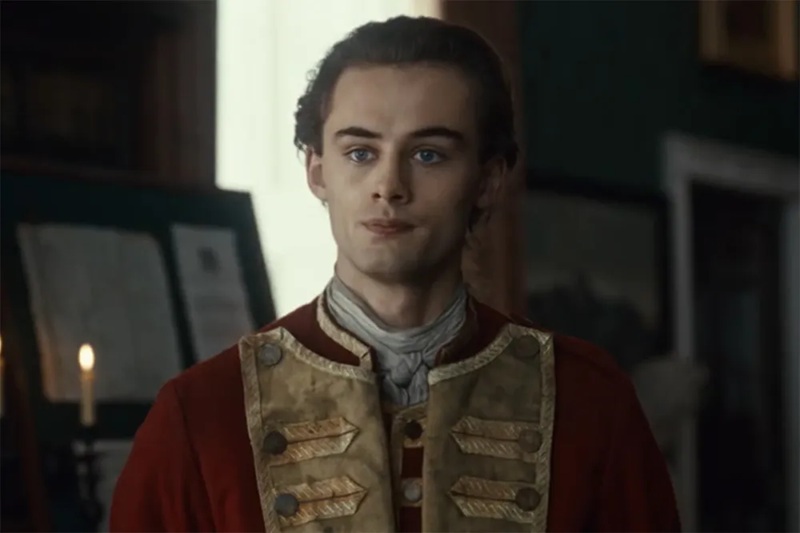
Young Washington (William Franklyn-Miller) was obsessed with becoming a British officer. Denied a “formal” education and “stuck” in the colonies, George is denied a commission into the British Army. The film needs us to know that he’s a scrappy underdog. This is a fertile fiction, but we’re going to roll with it. Do keep in mind, George Washington came from wealth and was about as “underdog-gy” as Donald Trump, but, hey, it’s true the Brits denied him a commission. But luckily this sad sack loathsome colonial worm-boy -on the recommendation from his brother- gets an assignment as a cartographer in the Virginia Militia. One mild adventure later and George is promoted above his station, where he escalates a war and faces ugly battlefield defeat at the hands of the French.
Oops.
I know we’ve been over this territory before but … for those in the back, minorities and poor people are not allowed to fail like this. No matter how you set this scene, George Washington screwed up and was allowed to return home not a prisoner, not universally shamed, essentially unscathed, and still a very wealthy young man. This turned out to be a very good thing. George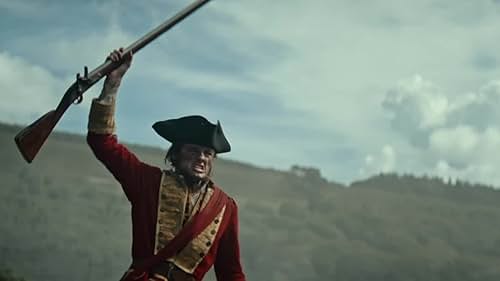 Washington was able to learn from his mistakes and prove himself courageous in the war to follow. Courage is definitely a battlefield asset and -to a lesser extent- a political asset. But we the audience are still left with, “Yes, and … where exactly were the qualities that made him the man who won the revolutionary war, became the first President of the United States, and -perhaps more importantly in the Trump era- voluntarily ceded power?
Here’s the thing – is Young Washington all that bad? Hmmmm, no. But it is very one-dimensional. Even its champions can’t escape that label. The film builds to a climactic scene which requires great courage and delivers. The thing is, it builds towards that scene on false information and privileged behavior, all of which the movie ignores completely. Who deserves the land? The people who own it or the people who work it? Well, the people who “own” it are those who didn’t see land as something someone owns and the people who work it are largely the slaves of those who now do … and the film acknowledges the claim of neither group, instead lauding the Native American evaluation that George Washington has divinity in him, a conclusion which seems quite suspect given all we know now. It comes down to this – sycophantic nationalists can root their heads off for Young Washington, but they’ll still have questions. And if you had no idea this man was going to become the first president of the United States, Young Washington makes you wait for one scene of outstanding courage and then reaches some dubious conclusions about it.
When his father succumbed to the grave
This boy had to learn to be brave
A soldier he would be
After attempt #3
(Ignore where he owned more than one slave)
Rated PG-13, 121 Minutes
Director: Jon Erwin
Writer: Dierderik Hoogstraten, Tom Provost, Jon Erwin
Genre: The father of overrated films
Type of being most likely to enjoy this film: People who need to see George Washington as a model of courage, and little more
Type of being least likely to enjoy this film: Realists